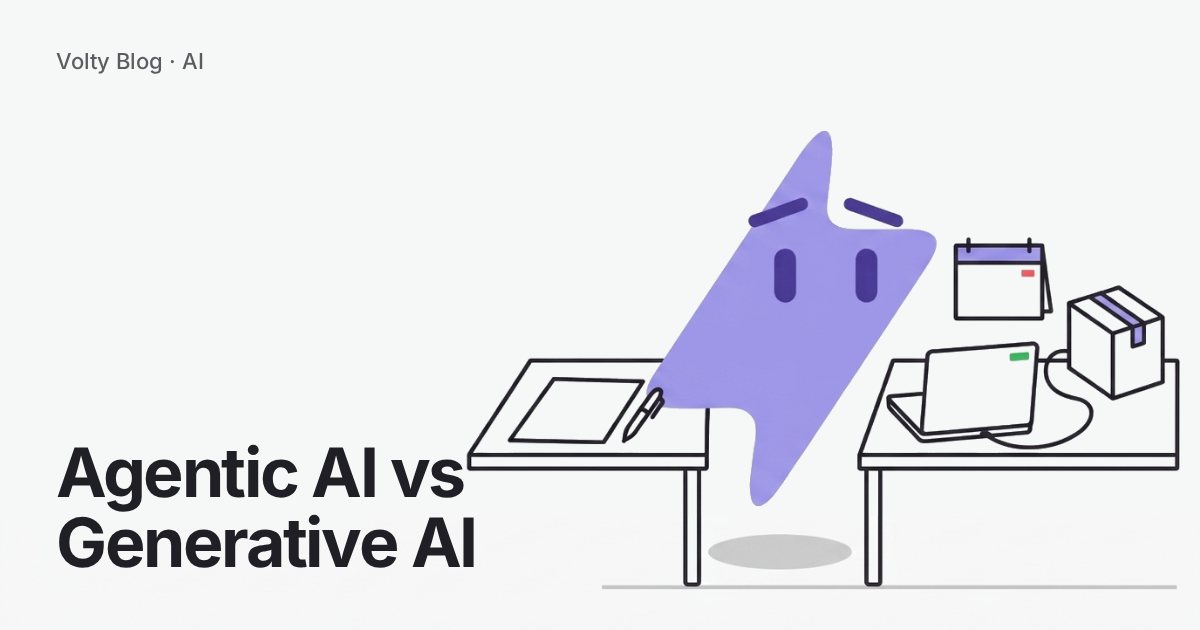


Generative AI creates new content, such as text, images or code, when someone prompts it, and a person then decides what to do with the result. Agentic AI is given a goal and works through several steps to reach it, choosing tools and taking actions in other systems, and in most products a generative model is the part doing the thinking inside it.
So the two are layers of one system. Generative AI is the engine that reads and writes. Agentic AI wraps that engine in tools, memory, rules and a loop, so it can finish a job instead of handing you a draft. The sections below set out where the line falls, why it matters for cost and risk, and how to tell which one a piece of work needs.
Generative AI in one paragraph
A generative model has learned patterns from very large amounts of data and produces new output that fits a prompt. Ask for a product description and you get one; ask for a summary of a long email thread and you get that. Each request is a single exchange. The model does not open your calendar, check stock or send anything unless some other software does those things with its output. The human stays in the loop by default, because the human has to copy, paste, approve or ignore what was produced.
Agentic AI in one paragraph
An agentic system starts from an outcome, such as "get this customer rebooked", and runs a cycle: read the situation, decide the next step, use a tool, check the result, and continue until the outcome is reached or it needs a person. The tools are what make it agentic: a booking calendar, a store, a CRM, an email sender. The generative model inside it chooses the steps and writes the words, while the surrounding software stores context between steps and enforces the limits the business has set. For a fuller walk through that cycle, see what AI agents are and how they work.
Side by side
| Dimension | Generative AI | Agentic AI |
|---|---|---|
| Starts from | A prompt | A goal |
| Produces | Content: text, images, code, audio | A completed task, plus any messages along the way |
| Number of steps | Usually one request, one response | Several, chosen as it goes |
| Touches other systems | No, unless a person or other software moves the output | Yes, through connected tools |
| Who acts on the result | A person | The system, within permissions |
| Typical failure | A wrong or bland draft | A wrong action, such as the wrong slot booked |
| Main control | Human review of the output | Permissions, approvals and logs |
| How you measure it | Quality of the content, time saved writing | Tasks completed, resolution rate, errors per task |
| Cost per use | One model call | Several model calls and tool calls per task |
The same request, handled both ways
An online homeware shop receives this message on a Sunday evening: "My order still hasn't arrived and it was meant to come Friday. Can you check, and if it's lost I'd like a refund."
With generative AI
A staff member opens the message on Monday, pastes it into an AI writing tool, and asks for a polite reply. The tool writes a warm apology that promises to look into it. The staff member then opens the store admin, finds the order, sees the courier marked it as delayed, edits the draft to add that, decides the refund question can wait until Wednesday, and sends. The AI saved a few minutes of typing. The customer waited a night and part of a morning, and the work of checking and deciding stayed with a person.
With agentic AI
The agent reads the message as it arrives, looks the customer up by phone number, finds the order in the connected store and reads its shipping status. It tells the customer within seconds that the parcel is with the courier, delayed, and gives the latest update. Because the customer raised a refund, it follows the shop's rule: refunds wait for a person. It sends the request to the shop owner, who approves or declines in one tap the next morning, and the agent tells the customer the outcome in the same chat. The conversation, the order lookup and the approval are all logged.
Both versions used a generative model to write the words. Only the second one used it to decide what to do next and then do it.
Why the difference matters for a business
Risk moves from words to actions
A bad generative draft costs a minute of editing. A bad agentic step can book the wrong appointment or promise a discount you never offered. That shifts where you put effort. With generative AI the work is reviewing output. With agentic AI the work is deciding which actions the system may take alone, which need approval, and which it must never take, then checking the logs. The framework in hire your AI agents, don't install them covers how to grant that autonomy in stages.
Cost is counted per completed task
An agent makes several model calls for one job, so it costs more per use than a single generation. The fair comparison is cost per completed task against the staff time the task used to take. A generative tool that saves two minutes of typing on a ten-minute job leaves eight minutes with your team; an agent that closes the conversation removes all ten, minus whatever review you choose to keep.
Data quality matters more
Generative output can be checked by the person reading it. An agent acts on what its knowledge and connected systems say, so a stale price list or a calendar that is not kept current turns directly into wrong actions. Before going agentic, make sure the source of truth for the job is current and in one place.
Which one a piece of work needs
Run each task through four questions.
Does it end in an action in another system (booking, updating, sending, ordering)? If no, generative AI is usually enough.
Does it repeat often, in a similar shape? Agentic AI pays off on volume; a once-a-month task rarely justifies setting up tools and rules.
Can a mistake be caught or undone? If an error is expensive and irreversible, keep a person approving that step even inside an agentic setup.
Is the right answer written down or stored somewhere? If it lives only in a senior employee's head, write it down first; neither kind of AI can use knowledge it cannot read.
Typical results of that test:
| Task | Better fit | Why |
|---|---|---|
| Writing a newsletter or social post | Generative | Ends in content a person reviews and publishes |
| Summarising a long customer thread for a manager | Generative | The output is the product; no action follows automatically |
| Answering "do you deliver on weekends?" at 11pm | Agentic, answer only | The reply is sent to the customer with no person involved, and the question repeats constantly |
| Rescheduling an appointment | Agentic | Needs a calendar lookup and a change |
| Qualifying a new lead and adding it to the CRM | Agentic | Several questions, then a record update |
| Approving a refund or a custom discount | Agentic with approval | The agent prepares it; a person decides |
Most customer-facing teams end up using both: agentic AI on the front line of the inbox, and generative help for staff when they write their own replies or need a summary. The AI agent vs chatbot guide makes a similar split for the tools you can buy.
How an agent and a team split the work
Prologue Clinic, SL Aesthetic Group's lifestyle medicine clinic, shows the split in practice. Volty answers the front of every inquiry on WhatsApp, greets returning patients by name, books appointments straight into the clinic's Plato Medical System and escalates to staff when a booking fails, while staff keep the conversations that need a person. The clinic reports man-hour savings of 6x, from 3 hours a day to 30 minutes a day per staff member. Jolene, Marketing Director, SL Aesthetic Group, put it this way: "Now with automation, we deliver faster, more consistent responses, because the chatbot handles them. And the humans focus on the higher-value, personalised customer service."

Agentic and generative AI in Volty
Volty is an AI helpdesk that runs both kinds of work in one place, and its pricing shows the split. An AI agent reply or action uses 2 to 5 AI credits, while a draft, prompt or summary for your team uses 1 credit, a gap that tracks the work involved: an agent reply can take several steps and tool calls, while a draft or summary is one piece of writing for a person to use.
On the agentic side, the agent answers customers on WhatsApp, Instagram, Messenger, email and web chat from your own information, and takes actions in systems you connect, with HubSpot, Google Calendar, Notion, Shopify and Slack built in. Your staff choose which actions happen on their own and which come to them first, and each inbox chooses whether Volty replies by itself, drafts for your team, or stays out. When a teammate corrects a reply, Volty keeps the lesson, and you can see every lesson and who approved it.
Volty Plus is US$159 a month in the US market and includes 15,000 AI credits; prices can change, so check the pricing page. To try the agentic side on your own customer messages, start with the WhatsApp AI agent and its 7-day free trial.
Frequently asked questions
What is the difference between agentic AI and generative AI?
Generative AI produces content, such as text, images or code, in response to a prompt, and a person decides what to do with it. Agentic AI is given a goal and carries out several steps to reach it, calling tools and taking actions in other systems. Most agentic systems use a generative model as their reasoning engine.
Is ChatGPT generative AI or agentic AI?
ChatGPT is built on generative AI, and a plain conversation with it is a generative use: you ask, it writes. It behaves more like agentic AI when it is given tools and allowed to use them across several steps toward a goal, such as searching, running code or acting in a connected app.
Is agentic AI better than generative AI?
Neither is better in general; each suits different work. Generative AI is the right fit when a person wants a draft, summary or idea and will act on it. Agentic AI is worth its extra cost and oversight when the work is a repeatable task that ends in an action, such as booking or updating a record.
Does agentic AI replace generative AI?
Agentic AI does not replace generative AI, because it is built on top of it. The generative model reads requests, plans steps and writes replies, while the agent software adds tools, memory, rules and a loop that keeps going until the task is done.
What are the risks of agentic AI compared with generative AI?
The main extra risk of agentic AI is that a mistake becomes an action, such as a wrong booking or an unwanted refund, instead of a draft a person could ignore. Businesses manage it with approvals for costly actions, a draft period before full automation, limited tool permissions and a log of every step.