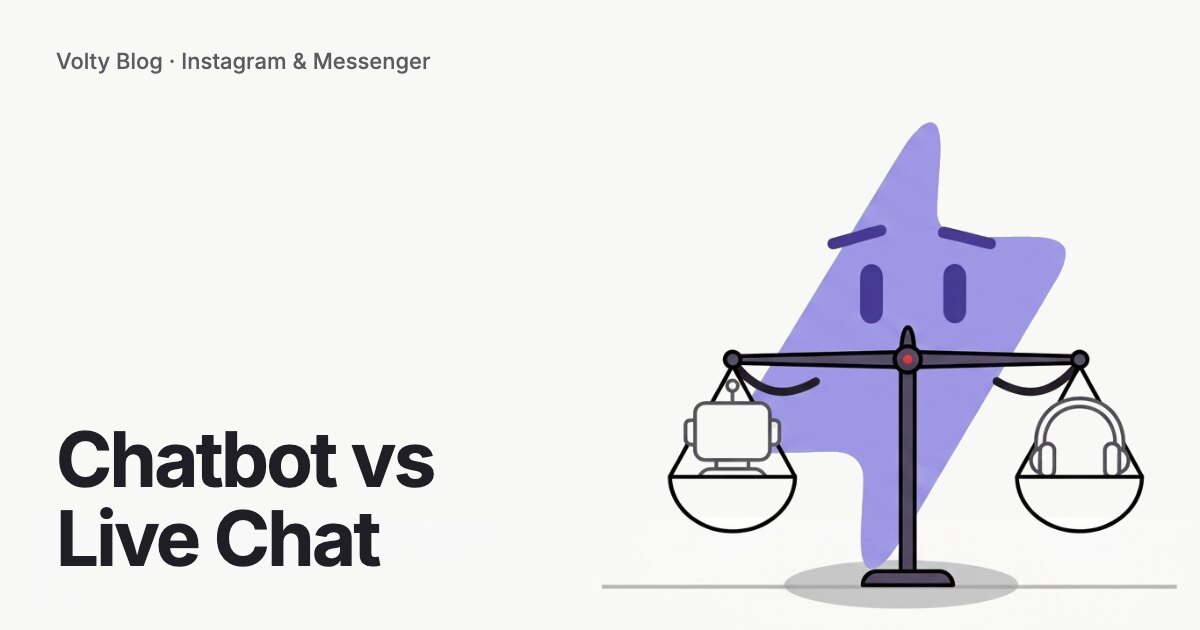


A chatbot answers visitors automatically, at any hour, from fixed rules or from an AI model, while live chat connects them to a person on your team. Neither wins in every case: the bot is better at speed and repeat questions, people are better at judgment and relationships. Many businesses get the best result from a hybrid in which the bot goes first and hands over cleanly.
The two options in plain terms
A chatbot is software that replies to messages. Older chatbots follow a decision tree: the visitor taps a button, and the bot shows the next fixed message. Newer AI agents read the question in free text and answer from your business's own information. Both can run all day and night.
Live chat is a conversation with a person. It might happen in a website widget, on WhatsApp or in any other channel, and what defines it is that a teammate reads and writes each reply. The quality can be high, but it depends on who is online.
Side by side
| Factor | Chatbot | Live chat |
|---|---|---|
| Availability | All hours | Staffed hours only |
| First reply | Seconds | Minutes, depending on queue |
| Cost as volume rises | Mostly flat after setup | Rises with headcount |
| Complex or emotional questions | Weak, should hand over | Strong |
| Consistency of answers | High, if the source information is right | Varies with each person |
| Setup effort | Needs knowledge and testing | Needs hiring and training |
| Risk | A wrong answer given confidently | A slow or missed answer |
Where a chatbot is the better choice
Questions repeat. If ten questions make up most of your messages, an agent can answer them all without tiring.
Messages arrive outside staffed hours. A visitor at midnight gets an answer instead of an email form.
Speed decides the sale. Cake Inspiration, a custom cake studio, had replies that took up to 9 hours and only in staffed hours. After it used Volty, its median reply fell to 5 seconds and 91% of conversations were resolved without a human, per its case study. The studio also reports a 75% reduction in lost leads, from roughly 15 a day to 3 or 4.
You need the same answer every time, such as prices and policies.

Where live chat is the better choice
The question is a complaint, a refund or something where the customer is upset.
The sale is large or custom, and the customer wants to deal with a human.
The facts are unclear or change daily and nobody has written them down.
Volume is low enough that a person can reply to every message quickly.
Why the hybrid usually wins
The cake studio's 91% figure points to the model that works: the bot resolves the bulk and the rest go to a person. The same case study says the remaining conversations were handed off to a designer, so the designers spent their time on orders while Volty took the repeat questions. A hybrid works when three things are true.
The bot knows its limits. It hands over when it is unsure, when the customer asks for a person, or when the topic is one you have marked as sensitive.
The handover carries context. The teammate sees the whole thread, so the customer does not repeat their question.
People can correct the bot. When staff see a wrong answer, they fix it once and it stays fixed.
How to decide for your business
| If this describes you | Start with |
|---|---|
| Under 20 chats a day, mostly bespoke | Live chat, plus an away message for off-hours |
| Over 50 chats a day with many repeats | A hybrid, with the AI answering first |
| Bookings or orders at all hours | A hybrid, with the AI able to book or take details |
| Regulated or sensitive topics | Live chat for the sensitive ones, AI for logistics |
| Chats on WhatsApp and Instagram as well as the website | One agent and one inbox across channels |
These thresholds are rough rules of thumb, so adjust them to your team's size and how fast customers expect an answer.
A cost illustration with invented numbers
Suppose a shop gets 1,500 chat messages a month, and a person takes about 2 minutes to write each reply, including reading and looking things up. That is 50 hours a month of reply work. If 70% of messages are repeat questions, an agent that handles them removes about 35 of those hours and leaves 15 hours for conversations that need a person. These figures are an illustration only, so count your own messages and your own handling time before you decide.
The arithmetic matters less than what the saved hours buy. The same staff can follow up quotes, call back unhappy customers, or simply answer faster at the peak hour, when queues form.
What goes wrong on each side
Chatbot failure modes
A decision-tree bot that cannot understand a free-text question and loops the visitor back to a menu.
An AI agent answering from out-of-date information, such as last quarter's price list.
No visible route to a person, which turns a small problem into a lost customer.
Live chat failure modes
Long queues at lunchtime and after work, when many customers have time to write.
Different agents giving different answers to the same question.
No coverage at night, so the first reply arrives the next morning, after the customer has asked someone else.
Each failure has a fix that the hybrid already contains: the bot covers the hours, the person covers the judgment, and shared notes keep both consistent.
Numbers to compare after launch
| Measure | What it tells you |
|---|---|
| Median first reply time | Whether speed improved where it matters |
| Share resolved without a person | How much work the bot really takes |
| Handover rate and reasons | Which questions the bot still cannot answer |
| Leads captured per 100 conversations | Whether chat produces sales conversations |
| Corrections made by staff per week | Whether the agent is improving |
| Customer ratings after chat | Whether people are satisfied with either route |
Compare the same measures before and after, and over the same weekdays. A weekend sale distorts any week it falls in.
Channels beyond the website
The chatbot versus live chat question is no longer only about a website widget. Customers write on WhatsApp, Instagram and Messenger as well, and each has its own rules about when a business may reply. Meta's policy gives a business a standard messaging window of 24 hours after most customer actions on Messenger and Instagram, and WhatsApp has its own 24-hour customer service window. A person who is slow to answer can miss that window entirely, while a bot answers inside it by default. This is one more reason the first reply is worth automating, even when you want people to handle the rest. The related guide on the WhatsApp 24-hour messaging rule explains how the window works there.
Rolling out a hybrid in four steps
Read a week of real conversations and mark the questions that repeat.
Write the answers once, with prices, hours and rules, and give the agent those sources.
Test conversations yourself, including awkward ones, and set which topics must always go to a person.
Launch with staff reviewing early replies, then loosen review as the answers prove reliable.
To see what the web side looks like, read AI live chat. For the wider difference between a bot and an agent, see AI agent vs chatbot.
Do both in Volty
Volty puts the chatbot and the live chat in one place. Its AI agent answers on your website chat, WhatsApp, Messenger, Instagram and email from the same knowledge, and each inbox decides whether the agent answers on its own, drafts for staff to approve, or stays out. When a teammate takes a conversation, the agent steps back, and everything is visible in the shared inbox. Try it free for 7 days from the Website and App AI page.
Frequently asked questions
What is the main difference between a chatbot and live chat?
A chatbot replies automatically, either from fixed rules or from an AI model that reads the question. Live chat connects the visitor to a person on your team. The first is available at all hours, and the second handles questions that need judgment.
Will a chatbot replace my live chat agents?
Usually not. It changes their work: the bot takes repeat questions, and staff spend their time on complaints, quotes and sales conversations. Keep a clear route to a person at all times.
Which is cheaper, a chatbot or live chat?
Live chat cost is mostly staff time, so it rises with volume. A chatbot has a software cost that stays flatter as volume grows, but it needs setup and regular review. For high volumes of repeat questions, the bot is generally the cheaper way to answer them.
Do customers prefer talking to a person?
It depends on the question. A person is preferred for a complaint or a hard decision. For a simple factual question, many visitors want an answer in seconds and care little who gives it. Clear handover to a person is what keeps both groups satisfied.
What is a hybrid approach?
A hybrid setup lets an AI agent answer first and hand the conversation to a teammate, with the full thread, when a person is needed. Both work in the same inbox, so the customer does not repeat themselves.